APTS Website Redesign
Project Info
Client
Asia Pacific Theological Seminary (APTS)
Role
Lead UI/UX Designer & Web Designer
Timeline
Jul – Oct 2024
Overview
Founded in 1964, Asia Pacific Theological Seminary is the foremost Pentecostal-Charismatic graduate seminary in the Asia-Pacific region. For six decades, APTS has trained thousands of theological leaders — graduates now serving in churches, missions organizations, and ministry leadership roles across the globe. The institution carries real weight: multiple accreditations from CHED, ATA, APTA, and ATESEA, a library collection that supports serious graduate scholarship, and an international student community drawing from countries across the Pacific.
What it did not have was a website that reflected any of that.
The old site struggled to communicate the scope and credibility of the institution to the people who mattered most: prospective students weighing a life-changing graduate degree, international applicants navigating admissions from abroad, and donors considering whether APTS was an organization worth supporting. As Lead UI/UX Designer and Web Designer, my task was to close that gap — building a digital presence worthy of a seminary with this history and this mission.
The Design Problem
Seminary websites occupy a peculiar corner of higher education design. They need to work simultaneously as a recruitment tool (converting prospective students), an administrative portal (serving current students, faculty, and staff), an institutional showcase (communicating accreditation, programs, and credibility to partners and donors), and a community platform (sharing news, events, and the cultural life of the campus). Most seminary sites fail because they try to do all of this at once, with no clear hierarchy, and end up serving none of these audiences well.
The central design question: how do you honor a 60-year institution's gravitas while making the site approachable and action-oriented for a new generation of prospective students exploring a graduate theological education?
The answer could not be to design something generic and safe — that would undermine the distinctiveness of what APTS actually is. But it also could not be so traditional that it felt inaccessible to international students in their 20s and 30s researching options online.
Understanding the Users
The site serves four meaningfully distinct audiences, each with different needs and entry points:
Prospective Students — the primary recruitment audience. Many are already in ministry or considering it; they're evaluating APTS against other seminaries and asking whether this institution can form them academically, spiritually, and professionally. They need program clarity, a sense of community and campus life, financial information, and a clear path to applying or making contact.
International Applicants — a significant portion of APTS's student body comes from across the Asia-Pacific region and beyond. The admissions process, visa considerations, and campus housing information carry extra weight for this group, and the site needs to make them feel like the institution has thought about their specific journey.
Current Students, Faculty & Staff — operational users who need efficient access to Moodle (the LMS), academic calendars, course catalogs, registrar services, and student life resources. For this audience, navigation speed and findability are everything; they're not browsing, they're looking for something specific.
Donors & Institutional Partners — individuals and organizations evaluating whether to contribute financially or establish academic partnerships. They need to quickly understand APTS's scope, legitimacy, and impact. The President's message, accreditation credentials, and graduate testimonials all speak to this group.
Key Design Challenges
1. Navigation at Scale The APTS site carries a genuinely large content structure: Academics (programs, calendar, catalog, faculty, research), Admissions (requirements, process, registrar), Finance (tuition, financial aid, scholarships), Student Life (spiritual life, campus life, services, policies, Global Missions Center), Library, Guest Services, and News & Media. This is not unusual for a university-scale institution, but it means the navigation architecture is load-bearing in a way it isn't on simpler sites. Get it wrong, and users abandon before they find what they need.
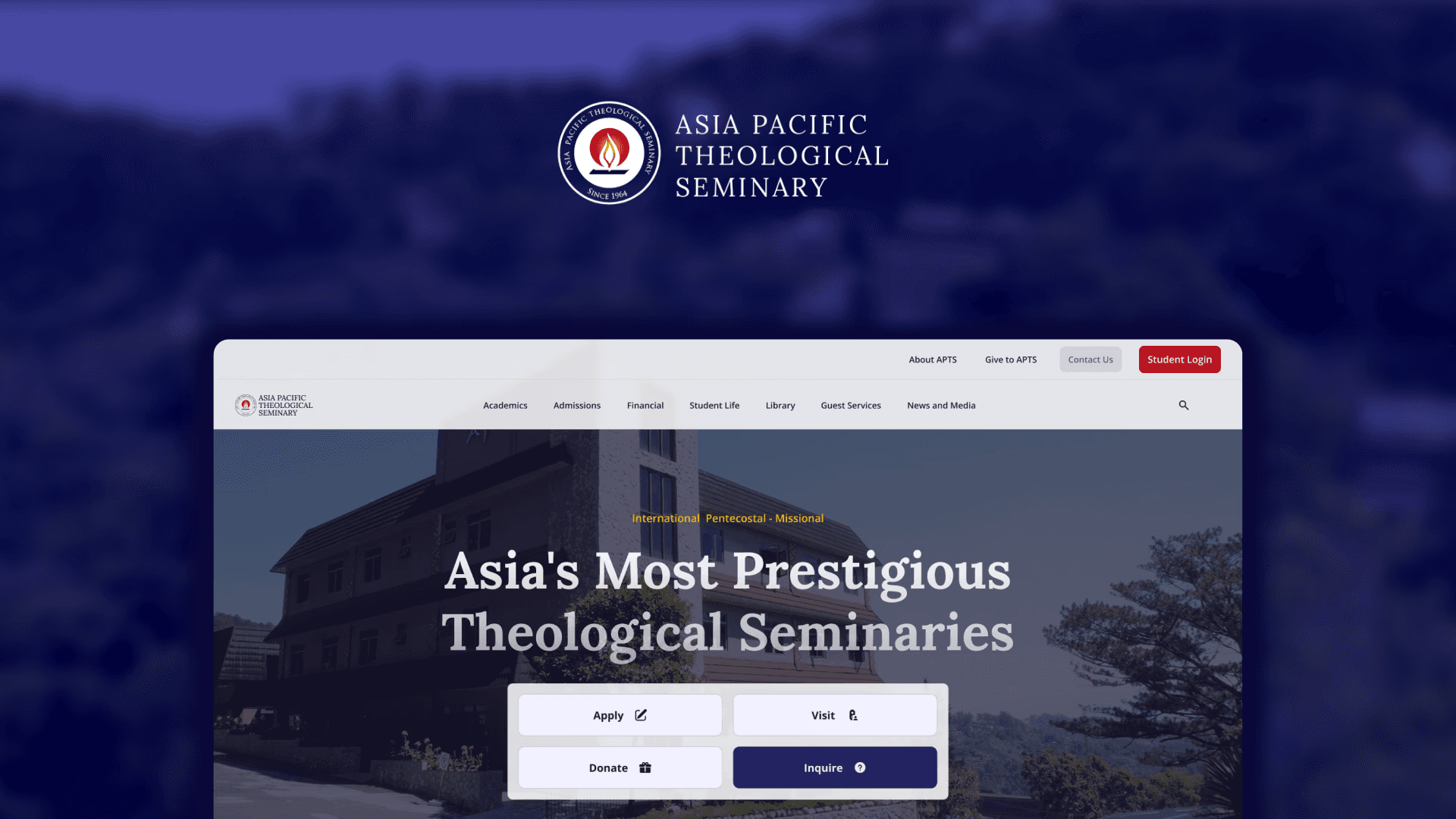
I designed the primary navigation as a deep mega-menu system that exposes the full site hierarchy without requiring multiple clicks to orient oneself. Structuring it around the user's journey stage — Academics, Admissions, Finance, Student Life, rather than APTS's internal organizational chart meant each section answered a natural user question: What can I study? How do I get in? What will it cost? What is life there like?
2. Conveying Institutional Weight Without Feeling Heavy APTS has been training ministers since 1964 and holds accreditations recognized across multiple countries. That credibility matters enormously to the people considering entrusting it with their graduate education. But institutions often communicate this through walls of text and formal language that feel impenetrable.
I worked to surface APTS's credentials visually and concisely, institution statistics (graduation rate, student-to-teacher ratio, degree programs, years of excellence, library collection) presented as a clean at-a-glance dashboard on the homepage, accreditation logos placed prominently without being declarative, and the President's message given its own visual moment as a signal of leadership and voice.
3. Student Voices as the Real Conversion Tool The most persuasive content on the APTS site isn't institutional copy, it's the student testimonials. Graduates from Fiji, Tonga, Spain, and the USA describing what APTS did for their faith and their ministry are more compelling to a prospective student than any program description. I designed the testimonials section to give these voices prominent placement and visual weight: full-quote treatment, attributed to real people with their degree and country, in a carousel that invites reading rather than skimming.
4. Designing for Dual CTAs: Apply and Inquire Unlike a commercial site with a single conversion goal, APTS needs to capture two types of prospective students: those ready to apply, and those still researching. Forcing everyone down an application flow loses the second group; leaving the CTA too soft loses the first. I designed the hero section with four parallel CTAs, Apply, Donate, Inquire, Academic Calendar, each addressing a different readiness level and audience, with visual hierarchy placing Apply and Inquire as the primary pair.
5. Guest Services as an Unexpected Dimension Unusually for a seminary, APTS offers lodgings, wedding venues, and conference facilities — a genuine revenue stream and community service that also signals something about the character of the campus. This content needed to be integrated naturally into the site without disrupting the dominant educational narrative. I placed it in the navigation as its own category, visible but not competing with the admissions-focused sections.
6. Integrating an AI Chatbot Without Breaking the UX The project also included implementing an AI-powered inquiry chatbot to handle the high volume of repetitive questions prospective students ask about programs, fees, admission requirements, campus facilities, and housing. The design challenge was positioning this feature in a way that felt genuinely helpful rather than evasive, a first point of contact that could answer straightforward questions immediately while making it easy to escalate to a real person for nuanced inquiries. I designed the chat interface to sit persistently accessible without dominating the page, with clear escalation pathways so users never felt trapped in an automated loop.
Design Process
Discovery & Content Audit
I began with a thorough audit of APTS's existing site and content — mapping what existed, what was missing, what was outdated, and what was deeply buried. This gave a clear picture of the full content scope before any structural decisions were made.
Information Architecture
The IA work was the most consequential part of the entire project. With a site this large, every navigation decision has downstream consequences. I organized the structure around the user journey stages identified in the audience analysis, tested the hierarchy against realistic task scenarios (Can a prospective student from overseas find admission requirements in under three clicks? Can a current student reach Moodle from any page in one click?), and refined before moving to visual design.
Visual Direction
The visual direction needed to honor APTS's identity as a serious, established seminary while feeling contemporary enough to recruit a new generation of students. I worked with a deep navy and white primary palette — institutional without being cold — anchored by full-bleed photography of the campus, student life, and graduation moments. Typography is clean and legible at all sizes, supporting both the long-form content (program descriptions, news articles, the President's message) and the scannable content (stat dashboards, navigation menus, accreditation logos).
Component Design & Responsive Layout
Every section of the site was designed as a discrete content module with consistent internal logic: a header, a focused content block, and a clear next action. This kept the experience navigable across the full depth of the site. All layouts were built responsively, with particular attention to the mega-navigation collapsing cleanly to a mobile menu that preserved the full hierarchy without becoming unusable on smaller screens.
Design Outcomes
The redesigned APTS site launched in late 2024 and now serves as the institution's primary platform for student recruitment, current student support, and institutional communication. The site gives prospective students, whether they're in the Philippines, Fiji, the USA, or Spain, a clear, credible, and welcoming introduction to what APTS offers. The navigation structure handles the full content scope without overwhelming users, and the design communicates a 60-year institution with the confidence that history deserves.
Reflection
University and seminary websites are one of the hardest categories of institutional design. The content scope is enormous, the audiences are genuinely different, and the institution often has a strong sense of its own identity that must be honored, not overwritten. What I found on this project is that the most valuable design contribution wasn't any individual screen or visual treatment: it was the disciplined work of prioritizing. What does a prospective student need to feel within the first thirty seconds? What can wait until the second page? What needs to be surfaced always, everywhere, for current students? When those questions are answered clearly, the visual design has clarity to follow.
© 2026 Kurt Lee Gayao