Cybermeds Mobile App
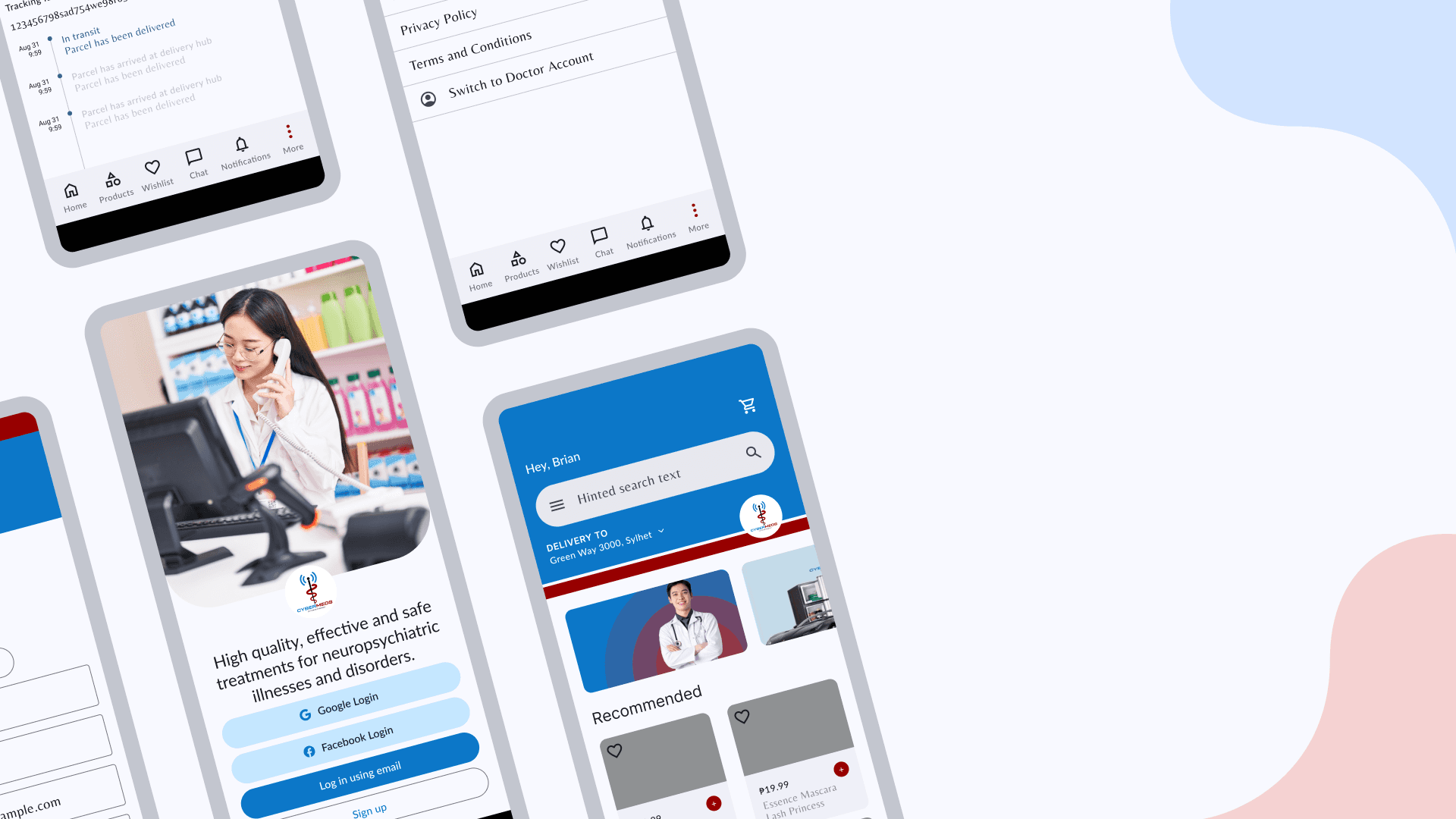
Project Info
Client
Conjug8 Corporation
Role
Lead UI/UX Designer
Timeline
Aug 2024 - Jul 2025
Overview
Neuropsychiatric medications in the Philippines have always been difficult to access — stigmatized, hard to find, and often only available through limited retail channels. When Conjug8 Corporation, a leader in neurological and mental health products, set out to build a mobile app that would change that, the design challenge was just as complex as the clinical one: how do you create a digital pharmacy experience that feels safe, trustworthy, and effortless for users navigating deeply sensitive health needs?
As Lead UI/UX Designer, I was responsible for shaping the entire product experience — from initial user flows and wireframes through to high-fidelity prototypes and a final design system handed off to the development team.
The Design Problem
The original brief focused on building an e-commerce platform for medication purchases. But as I dug deeper into the context, it became clear the core design problem was more nuanced:
How do you make purchasing neuropsychiatric medication feel as simple and stigma-free as ordering from any other online shop — while still meeting the heightened expectations users have around trust, data privacy, and medical accuracy?
This tension between accessibility and sensitivity drove every key design decision throughout the project.
Understanding the Users
Two distinct user types emerged early in the discovery phase:
General Consumers — patients or caregivers seeking convenient access to medications, often with limited familiarity with digital health tools. Their primary needs were simplicity, reassurance, and clear product information.
Medical Professionals — doctors and pharmacists who needed a different kind of interface: faster navigation, professional-grade product detail, and trust signals appropriate to their expertise.
These two user types required different entry points, different content hierarchies, and different tonal approaches — all within the same app.
Key Design Challenges
Trust at First Touch Healthcare apps carry a higher burden of credibility than most. Users need to feel "immediately" that their data is safe and that the products they're seeing are legitimate. This shaped everything from the visual language (clean, clinical-but-warm) to the onboarding flow, which was designed to be transparent about data use without being overwhelming.
Reducing Friction in a Sensitive Purchase Flow Buying neuropsychiatric medication involves more steps than a typical e-commerce transaction: product selection, prescription considerations, payment, and in some cases, locating a nearby hospital for follow-up. Each step had to be clear, low-anxiety, and forward-moving. I mapped out the full purchase journey to identify and eliminate every unnecessary decision point.
Designing for Dual Audiences Without Duplicating Effort Rather than building two entirely separate interfaces, I designed a profile-based system where the same core screens adapt their content and navigation depth depending on whether the logged-in user is a consumer or a medical professional. This kept the experience coherent and the development scope manageable.
MVP Speed Without Sacrificing Usability The client needed a working app in four months for a soft launch. This meant ruthless prioritization. I worked closely with the project manager and development team to define which design decisions were load-bearing for launch and which could be iterated post-MVP — ensuring we shipped something usable, not just something fast.
Design Process
Discovery & Research
I began by auditing competitor apps in the Philippine healthcare and e-commerce space, identifying patterns that users already understood and gaps that represented opportunities to differentiate. I also reviewed the client's existing brand assets and product catalog to understand the visual and content landscape.
Information Architecture
Given the range of features — e-commerce, rewards, hospital locator, content hub, notifications — organizing the app's structure was critical. I mapped out a card-sorting-informed navigation system that grouped features by user intent rather than business logic, making the app feel intuitive from the first open.
Wireframing & User Flows
I built detailed wireframes for all primary flows: onboarding, product browsing and purchase, rewards dashboard, hospital locator, user profile management, and notification preferences. Each flow was reviewed with the client and development team before moving to visual design, catching structural issues early and avoiding costly rework.
Visual Design & Design System
The visual direction balanced two competing needs: the clinical credibility expected of a pharmaceutical brand, and the warmth needed to make users with mental health needs feel at ease. The result was a clean, spacious UI with a restrained color palette — grounded in the client's brand blues but softened with accessible typography and generous whitespace.
I built a component-based design system in Figma covering typography, color tokens, iconography, buttons, form elements, cards, and navigation patterns. This gave the development team a clear, consistent reference and dramatically reduced back-and-forth during implementation.
Prototyping & Iteration
Key flows were prototyped at high fidelity for client review and internal usability checks. Feedback was incorporated iteratively across three design phases aligned with the development sprints, allowing the design to evolve in step with the product without disrupting delivery timelines.
Feature Highlights (Design Perspective)
E-Commerce Flow — Designed for minimal taps from browse to checkout. Product cards lead with key information above the fold; the cart and payment flow were simplified to reduce abandonment at the most anxiety-prone moment of the journey.
Rewards Program — The points dashboard was designed to be immediately legible: your balance, your tier, and your next reward in a single glance. Gamification elements were kept subtle and tasteful, appropriate to a healthcare context.
Hospital Locator — Integrated Google Maps in a way that felt native to the app rather than bolted on. Users can filter by proximity and access directions in one tap, bridging the gap between digital and in-person care.
Dual User Profiles — The profile setup screen was designed as a clear first-run choice that shapes the entire subsequent experience, with both paths explained in plain language so users felt confident selecting the right one.
Outcome
CyberMeds launched on both the Apple App Store and Google Play Store in May 2025. The phased design process allowed the team to hit the December 2024 MVP soft launch on schedule while continuing to refine and expand the experience through to full release.
The app established Conjug8 Corporation as one of the first companies in the Philippine neuropsychiatric space to offer a fully digital purchase experience and expanding access to medications for patients nationwide who previously had limited options.
Reflection
This project reinforced for me that healthcare design is where UX decisions carry the most weight. Every friction point isn't just an inconvenience, it's a barrier to someone getting the care they need. The most important work on CyberMeds wasn't any single screen; it was the sustained effort to make a complex, sensitive experience feel simple, safe, and human.
© 2026 Kurt Lee Gayao